TLDR
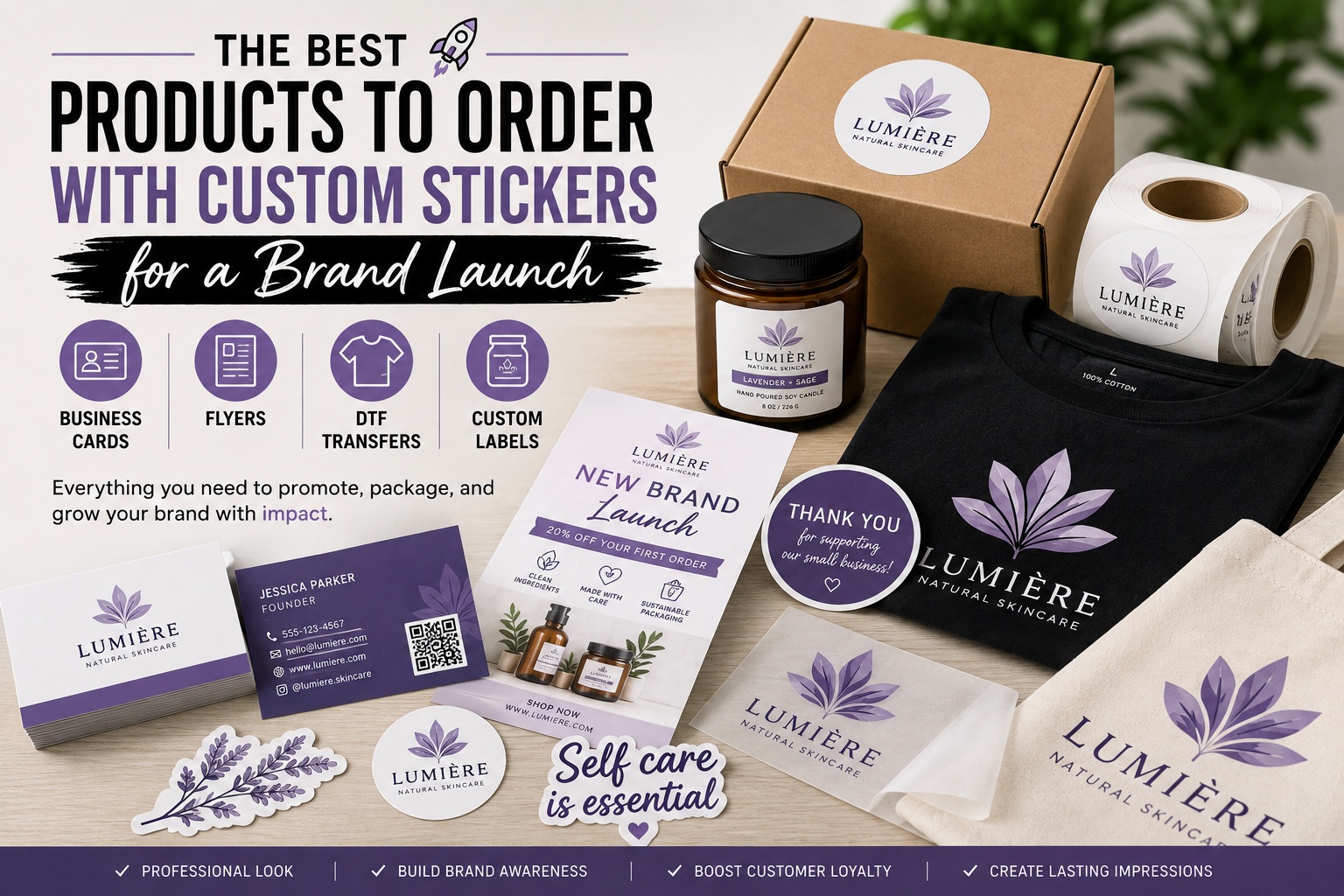
Custom stickers are a strong starting point for a brand launch, but they work even better when paired with the right printed products. Business cards help with networking, flyers explain the offer, labels polish your packaging, and DTF transfers let you create branded merch or team apparel. The best launch setup is simple: order the products that support how people will first meet, buy from, and remember your brand.
A brand launch has a lot of moving parts. You need something people can notice, something they can take with them, something that makes your packaging look finished, and something that keeps your name visible after the first interaction.
That is why choosing the best products to order with custom stickers matters. Stickers are flexible, low-friction brand pieces, but they should not carry the whole launch alone. They work best as part of a small, practical launch kit that includes business cards, flyers, labels, and apparel or merch when it makes sense.
The goal is not to order every printed product available. The goal is to build a tight set of launch materials that feels consistent, useful, and easy to hand out or pack with orders.
Start With Custom Stickers as the Anchor
Custom stickers are often the easiest launch item to justify because they can do several jobs at once. You can use them as giveaways, packaging seals, product extras, event handouts, laptop stickers, water bottle stickers, or small thank-you gifts inside orders.
That flexibility matters during a launch. You may not know yet which sales channel will perform best. You might be testing markets, pop-ups, ecommerce, wholesale samples, local events, or influencer mailers. Stickers can move between all of those without feeling out of place.
For a brand launch, keep at least one sticker design simple and recognizable. A clean logo sticker or brand mark gives you something you can use almost anywhere. Then, if budget allows, add one more sticker with a slogan, mascot, icon, or design people would actually want to keep.
Good launch sticker ideas include:
- A clean logo sticker
- A slogan or catchphrase sticker
- A product-themed sticker
- A small thank-you sticker
- A QR code sticker for menus, signups, or reorder pages
- A limited launch edition sticker
The best sticker is not always the most detailed one. For launch use, clarity usually wins. People should understand the design quickly, especially if the sticker is being handed out at an event or included in packaging.
Business Cards for Networking and Local Introductions
Even if your launch is mostly online, business cards still have a place. They are useful at markets, pop-ups, trade shows, local meetings, vendor events, pickup orders, and casual conversations where pulling out a phone feels slower than handing someone a card.
A business card should not try to explain everything. It should make the next step clear.
Include:
- Brand name
- Logo
- Website
- Email or contact method
- Social handle
- QR code if useful
- A short line about what you sell or offer
For a brand launch, the back of the card can do extra work. You can add a launch discount, a short product description, a “scan to shop” QR code, or a simple tagline. Keep it clean. A cluttered business card feels less confident, even if the business behind it is strong.
Business cards also pair well with stickers. You can attach a small sticker to the card, include both in an order, or use the sticker as a small visual cue that makes the card feel less generic.
A good launch card should answer one question fast: “What should I do next?”
Flyers for Explaining the Brand Quickly
Flyers are useful when your launch needs more explanation than a sticker or business card can provide. They give you room for a product lineup, a launch offer, a local event announcement, a menu, a service list, or a short brand story.
Flyers are especially helpful for:
- Grand openings
- Pop-up shops
- Farmers markets
- Local service launches
- Product drops
- Restaurant or food brand launches
- Community events
- Retail counter displays
- Package inserts
The mistake with flyers is trying to fill every inch. A flyer should be easy to scan. Use one clear headline, a few short details, strong product photos or graphics, and one main call to action.
For example:
“New local candle studio now open.”
Then add the essentials: what you sell, where to find you, what makes the launch offer worth noticing, and how to order.
A flyer can also work as a package insert. If someone buys from you during the launch, include a flyer that shows the rest of the product line, explains your care instructions, or gives them a reason to come back.
Pair flyers with custom stickers by using the sticker as a visual highlight. A sticker can call out “New,” “Launch Offer,” “Limited Drop,” or “Scan to Shop.” It gives the flyer a more physical, layered feel without needing a complicated print setup.
Custom Labels for Packaging and Product Presentation
If your brand launch includes physical products, custom labels may be just as important as stickers. Labels help products look finished, organized, and ready to sell.
Use labels for:
- Product packaging
- Bottles and jars
- Bags and boxes
- Scent, flavor, color, or size variants
- Ingredient or care information
- Batch names
- Shipping and handling details
- Branded packaging seals
Labels are especially important if your launch involves products sitting on a shelf, table, counter, or display. A plain container may be functional, but a clear label tells people what the product is and why it belongs to your brand.
This is one of those details people may not consciously praise, but they notice when it is missing.
For launch labels, consistency matters. Use the same logo, colors, font style, and basic layout across your product line. If you sell multiple scents, flavors, sizes, or styles, create a simple system that changes only what needs to change.
For example:
- Same label shape
- Same logo placement
- Same product name area
- Same information layout
- Different color or small icon for each variant
That makes the product line feel connected without making every item look identical.
DTF Transfers for Apparel, Totes, and Launch Merch
DTF transfers are a strong add-on when your launch needs apparel or branded merch. They let you put your design on shirts, hoodies, tote bags, uniforms, event apparel, and small-batch merchandise.
This can work in a few ways.
First, you can create shirts or hoodies for your team. If you are working a pop-up, market, or launch event, matching apparel helps customers know who to talk to.
Second, you can create customer-facing merch. A good shirt or tote can give early customers a way to support the brand beyond the main product.
Third, you can make limited launch pieces. A small first-run shirt, tote, or hoodie can feel special without committing to huge inventory.
DTF transfers are best when you already have a clear design and a plan for the blank garments. Think through placement before ordering. A left-chest logo, sleeve print, tote bag graphic, or full-front design all feel different.
For most brand launches, simple merch is safer than overly complex merch. A clean logo tee or tote can last longer than a design that only makes sense for one campaign.
What to Order Together for Different Launch Types
The best products to order with custom stickers depend on how your brand is launching. A product-based ecommerce launch has different needs than a local service launch or a market booth.
For an ecommerce product launch, start with:
- Custom stickers
- Product labels
- Thank-you or insert cards
- Branded packaging seals
- Flyers that introduce other products
For a local event or pop-up launch, start with:
- Custom stickers
- Business cards
- Flyers
- DTF shirts for staff
- Labels for display products
For a service business launch, start with:
- Business cards
- Flyers
- Custom stickers
- Vehicle, laptop, or equipment stickers if relevant
- Simple leave-behind materials
For a merch-focused launch, start with:
- Custom stickers
- DTF transfers
- Product labels or size labels
- Flyers or cards with care instructions
- Packaging stickers
The cleanest launch kits usually have one product for awareness, one product for explanation, one product for packaging, and one product for follow-up.
Keep the Design System Consistent
A launch can start to feel scattered when every item looks like it came from a different place. Your sticker, card, flyer, label, and shirt do not need to be identical, but they should feel related.
Before ordering, set a simple brand system:
- One primary logo
- One simplified logo or icon
- Two or three core colors
- One or two fonts
- One short tagline
- One preferred QR code destination
- One main call to action
Then apply that system across everything.
Your business card might be clean and minimal. Your flyer might have more detail. Your label might be smaller and more functional. Your DTF shirt might be bolder. That is fine. They just need to feel like part of the same launch.
This is where custom stickers help. A consistent sticker design can tie together plain packaging, printed cards, flyers, and merch without making everything custom from scratch.
Order Quantities Based on Use, Not Guesswork
It is easy to over-order for a launch because everything feels important. But printed materials should match your actual plan.
Ask a few practical questions:
- How many orders do you expect in the first month?
- How many people will attend your launch event?
- How many packages need labels?
- How many flyers can you realistically distribute?
- How many team members need apparel?
- Will these designs still be usable after launch week?
For evergreen items like logo stickers, business cards, and basic labels, ordering more usually makes sense if you know you will keep using the same branding.
For time-sensitive items like launch flyers, dated event materials, or limited campaign stickers, be more careful. You do not want to be stuck with hundreds of pieces that are only useful for one weekend.
Common Mistakes to Avoid
A brand launch does not need to be perfect, but a few mistakes can make printed materials less useful.
Avoid ordering too many dated materials. Anything with a specific launch date, sale date, or event detail has a short life.
Avoid making stickers too detailed. Small stickers need simple designs, strong contrast, and readable text.
Avoid using different colors across every product. If your business card is navy, your flyer is teal, your label is lime, and your shirt is burgundy, the launch may feel disconnected.
Avoid hiding the next step. Every printed piece should point people somewhere: shop online, scan the code, follow the account, visit the booth, or contact the business.
Avoid treating packaging as an afterthought. If customers receive a product in plain or confusing packaging, the launch feels less complete.
A Simple Brand Launch Print Kit
For most small brands, a strong launch kit can be simple:
- Logo stickers for giveaways and packaging
- Business cards for conversations and local networking
- Flyers for events, inserts, or product explanations
- Custom labels for packaging and product organization
- DTF transfers for shirts, totes, or limited merch
That set covers the main launch moments: discovery, explanation, purchase, packaging, and memory.
You can always add more later. But starting with these pieces gives your brand a physical presence without turning the launch into a packaging project that eats the whole budget.
Conclusion
The best products to order with custom stickers for a brand launch are the ones that support real customer moments. Stickers help people remember you. Business cards make follow-up easier. Flyers explain the offer. Labels make products look finished. DTF transfers turn your logo or artwork into apparel and merch.
Start with the products that match your launch plan. Keep the design consistent. Order practical quantities. And make every printed piece point toward one clear next step.
A good launch kit does not need to be complicated. It needs to feel ready.